Drop Us a Line
Connect with Us
Hope Arrives, Every Life Deserves A Chance.
-
To More Inquiry
-
To More Inquiry
86898 23601
-
-
ICU Ambulance Service in Vasai, Mumbai
When a family member faces a life-threatening medical crisis, every second counts. Ayyappa Ambulance provides fully equipped ICU ambulance service in Vasai, Mumbai, with trained critical care teams ready to respond around the clock. Whether you are dealing with a cardiac emergency, post-surgical transfer, stroke, or multi-trauma case, our mobile intensive care units bring hospital-grade treatment directly to your patient from the very first minute of transport.
ICU Ambulance Response Time in Vasai: Coverage Zone and Arrival Commitment
One of the most critical questions families ask is: how quickly can an ICU ambulance actually reach us? In Vasai and the surrounding zones, we have mapped our dispatch zones and benchmarked response times against real route data – not optimistic estimates. Our goal is a dispatch-to-arrival time of 15 to 25 minutes across core Vasai zones under normal traffic conditions.
Vasai West (Vasai Road West, Papdy, Sopara)
10 to 18 minutes average response
Vasai East (Navghar, Manikpur, Sandor)
12 to 20 minutes average response
Nalasopara East and West
15 to 22 minutes average response
Virar East and West
18 to 28 minutes average response
Nallasopara coastal and rural pockets
20 to 30 minutes estimated arrival
Night-time dispatch is maintained with a dedicated fleet that does not share rotation with daytime non-emergency calls. This means at 2 AM on a Sunday, our response capacity is functionally equivalent to a weekday afternoon. We also service outlying areas within the Vasai-Virar Municipal Corporation limits on a case-by-case basis with slightly extended arrival windows.
How to Book an ICU Ambulance in Vasai in 3 Steps
We have designed our booking process to be as fast and frictionless as possible because time is the single most critical resource in any emergency. Here is exactly how it works:
Step 1: Call Our 24/7 Dispatch Line Immediately
Our emergency dispatch operators are available at all hours, including public holidays and nights. When you call, briefly describe the patient's condition, current location (building name, street, locality in Vasai), and the nearest landmark. You do not need to know the exact diagnosis - just describe what you are seeing. Our trained dispatcher will ask targeted questions to determine the correct ambulance type and crew configuration for your situation. Average call handling time before dispatch confirmation: under 90 seconds.
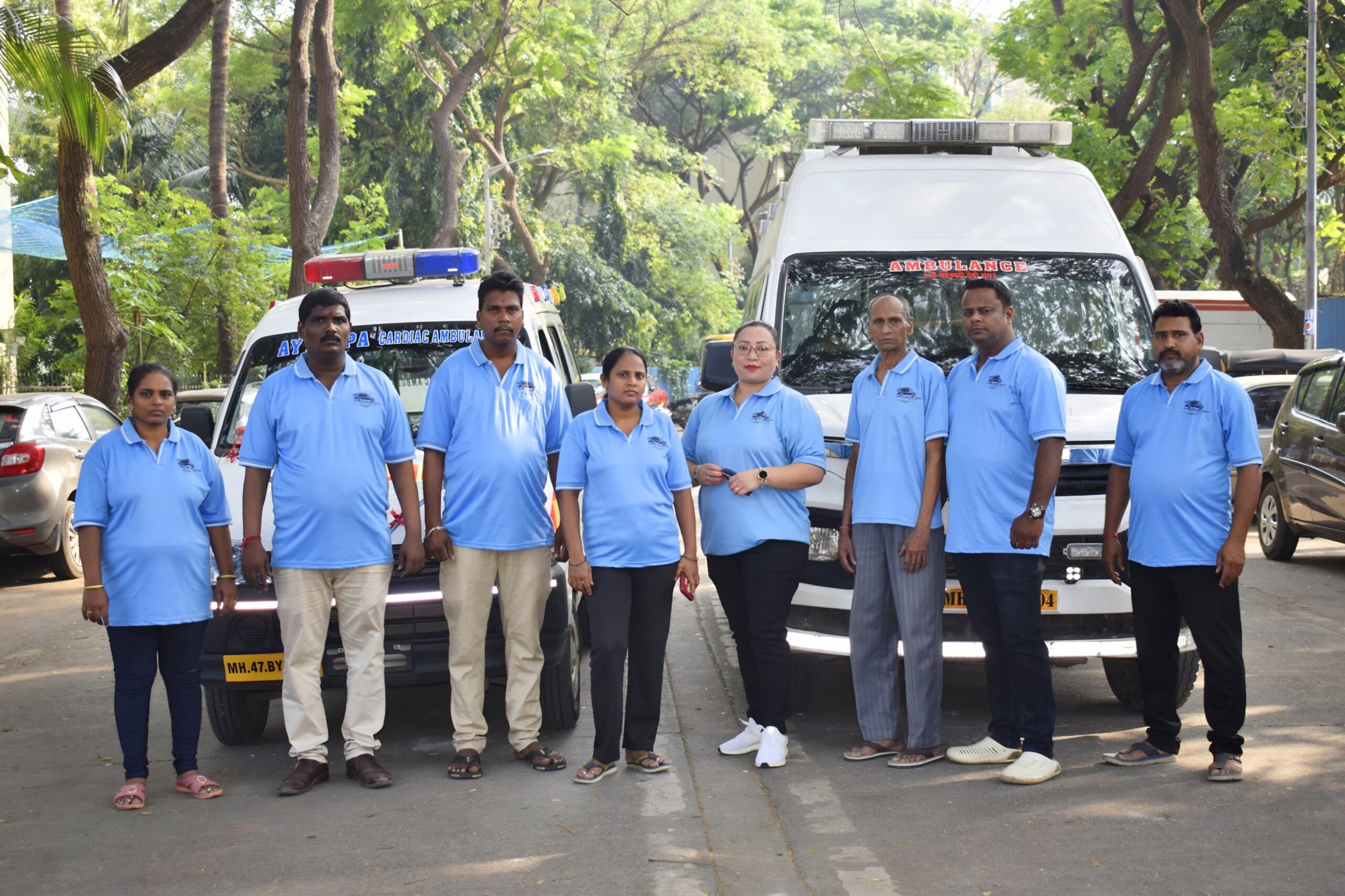
Certified Medical Staff On Board: Doctors, Paramedics and EMTs
Emergency Medical Technician (EMT) - Advanced Level
Certified in advanced airway management, cardiac rhythm interpretation, IV access, and drug administration under protocol. All EMTs complete regular competency re-assessment and Basic Life Support (BLS) and Advanced Cardiac Life Support (ACLS) recertification.
Paramedic or Critical Care Nurse (for high-acuity calls)
For patients requiring ventilator management, active vasopressor infusions, or post-operative critical monitoring, a qualified paramedic or registered critical care nurse accompanies the team. This ensures hands-on clinical decision-making throughout the transfer.
Trained Ambulance Driver with Emergency Response Certification
Our drivers are not general fleet operators - they are trained in rapid-response navigation across Vasai, Nalasopara, Virar, and Mumbai arterial routes, with working knowledge of hospital entry protocols and emergency bay access procedures.
ICU Ambulance Cost in Vasai, Mumbai: Transparent Pricing Breakdown
We understand that financial clarity matters during a medical emergency – families should not be negotiating prices at the moment of crisis. Ayyappa Ambulance maintains a transparent pricing structure with no hidden charges added after service delivery. All costs are communicated before dispatch confirmation.
| Charge Component | Approximate Range | Notes |
|---|---|---|
| Base Mobilisation Charge | Rs. 2,000 to Rs. 3,500 | Covers dispatch, crew preparation, and first 5 km of travel from the staging point |
| Per Kilometre Rate (Beyond Base) | Rs. 60 to Rs. 90 per km | Calculated on the actual route distance from pickup to destination |
| Ventilator Activation Surcharge | Rs. 1,500 to Rs. 2,500 | Applies when the ventilator is actively in use during transport, covering consumables and clinical management |
| Doctor or Specialist On-Board Add-on | Rs. 2,000 to Rs. 5,000 | Applicable for cases requiring a registered medical officer or specialist physician during transit |
| Night Surcharge (10 PM to 6 AM) | 10% to 15% of total bill | Covers additional crew standby costs and night-fleet operational expenses |
| Infusion Pump or Syringe Driver Usage | Rs. 500 to Rs. 1,000 | Per pump per trip; covers consumable lines and drug delivery accessories |
| Waiting Charges (Beyond 30 minutes at pickup) | Rs. 300 to Rs. 500 per 30 minutes | Applied only when delays are outside Ayyappa Ambulance's control, such as delayed patient preparation at the origin facility |
Contact Ayyappa Ambulance
ayyappaambulanceservices@gmail.com
Phone / Emergency
+91 8689823601
8689823601
Serving
Shop no 22, bmc market, Anand Nagar, Dahisar East, Mumbai, Maharashtra 400068
1. What Is an ICU Ambulance? (And Why Vasai Patients Need One)
An ICU ambulance is not simply a vehicle that carries a patient to the hospital. It is a mobile intensive care unit – a self-contained critical care environment staffed by trained medical personnel and loaded with life-sustaining equipment. Unlike a basic ambulance that provides oxygen support and basic first aid, an ICU ambulance can manage patients whose vital signs are actively deteriorating during transit.
In Vasai and the broader Vasai-Virar corridor, the distance to Mumbai’s tertiary care hospitals can range from 35 km to over 60 km depending on traffic and the specific destination facility. For a patient in critical condition, this travel time is not passive waiting – it is an active clinical window where the right interventions can determine survival and recovery outcomes. An ICU ambulance turns that window into continuous, monitored, intervention-ready care.
If your loved one in Vasai requires any of these levels of support, calling a basic oxygen ambulance is not enough. Our ICU ambulance service in Mumbai is purpose-built to bridge the gap between where your patient is right now and the definitive hospital care they need.
Conditions that specifically require ICU ambulance transport include:
Acute cardiac events
Heart attacks, severe arrhythmias, or post-cardiac arrest stabilisation where defibrillation and IV medications must remain immediately available throughout the journey.
Stroke and neurological emergencies
Patients with suspected stroke, traumatic brain injury, or seizure disorders require continuous neurological monitoring and airway management that basic ambulances cannot provide.
Post-surgical critical transfers
Patients discharged from surgery but still requiring ventilatory support, controlled IV drug infusions, or real-time hemodynamic monitoring during hospital-to-hospital transfers.
Severe respiratory failure
Patients on ventilators, those with acute respiratory distress syndrome, or chronic obstructive pulmonary disease exacerbations requiring controlled oxygen therapy and suctioning.
Multi-trauma cases
Road accident victims with internal injuries, fractures, and haemodynamic instability who need advanced airway protection and fluid resuscitation in transit.
Neonatal and paediatric emergencies
Critically ill newborns and children requiring specialised monitoring and temperature-controlled environments during transfer.
Our ICU Ambulance Equipment: Full Medical-Grade Setup in Every Vehicle
Every Ayyappa Ambulance ICU vehicle is fitted to a consistent, verified medical standard before it leaves the garage. We do not rotate equipment in and out depending on availability – each unit carries its full configuration for every deployment. Below is a complete breakdown of what is inside every ICU ambulance we operate from Vasai.
| Equipment | Clinical Purpose During Transport |
|---|---|
| Portable ICU Ventilator (Adult + Paediatric modes) | Manages breathing for patients who cannot breathe independently; controls tidal volume, respiratory rate, and oxygen percentage throughout transit |
| Cardiac Defibrillator (Biphasic) | Delivers electrical shocks to restore normal heart rhythm in ventricular fibrillation and pulseless ventricular tachycardia situations |
| Multi-Parameter Patient Monitor | Provides continuous real-time display of ECG, blood pressure, SpO2, EtCO2, temperature, and respiratory rate simultaneously |
| Syringe Infusion Pump (Dual channel) | Delivers precise IV drug infusions at controlled rates for vasopressors, sedatives, inotropes, and anticoagulants during transport |
| Suction Machine (Electric + Manual Backup) | Clears airways of secretions, blood, or vomit to prevent aspiration in unconscious or sedated patients |
| Portable Oxygen Cylinder (Jumbo D-Type) with Flow Meter | Provides sustained high-flow oxygen independently of the ventilator circuit; backup for extended transfers |
| Bag Valve Mask (Adult, Paediatric, Neonatal) | Manual ventilation backup in the event of ventilator failure or during patient transfers between the ambulance and the hospital bed |
| Crash Cart with Emergency Medications | Carries adrenaline, atropine, dopamine, lignocaine, dextrose, anticonvulsants, corticosteroids, and other resuscitation drugs |
| IV Access Kit and Central Line Tray | Enables peripheral and central venous access for fluid resuscitation and high-concentration drug delivery |
| Spinal Immobilisation Board and Cervical Collars | Prevents secondary spinal cord injury in trauma patients during loading, transport, and unloading |
| Hydraulic Stretcher with Foldable Side Rails | Enables safe patient loading at height-variable surfaces, including home floors, hospital beds, and emergency bay gurneys |
| Pulse Oximeter and Capnograph | Monitors blood oxygen saturation and end-tidal CO2 continuously to detect deterioration in ventilation and perfusion |
ICU Ambulance Routes: Vasai to Mumbai's Top Hospitals
One of the most practical concerns during a critical medical emergency in Vasai is the route and the destination. Families often need to transfer a patient to a Mumbai tertiary care centre where specialised treatment is available – but they have no way to safely and clinically transport them. Ayyappa Ambulance operates regular critical care transfer routes between Vasai and the following Mumbai hospitals:
Vasai to Kokilaben Dhirubhai Ambani Hospital, Andheri West
Approximately 42 km via the Western Express Highway. Estimated ICU ambulance transit time of 50 to 70 minutes depending on traffic. Frequently used for oncology, cardiac, and neurosurgery referrals.
Vasai to Hinduja Hospital, Mahim
Approximately 53 km. Estimated transit 60 to 85 minutes. Common route for complex cardiac, kidney, and multi-organ failure transfers.
Vasai to Wockhardt Hospital, Mira Road or Mumbai Central
Mira Road facility at approximately 22 km offers faster access for early stabilisation before onward transfer. Mumbai Central branch at 58 km for tertiary-level speciality care.
Vasai to Lilavati Hospital, Bandra
Approximately 50 km via the S.V. Road or Linking Road corridor. Frequent neurology and orthopaedics transfer route.
Vasai to Nanavati Max Hospital, Vile Parle
Approximately 44 km. Used for complex surgical cases and oncology treatment requiring Mumbai-based specialists.
Vasai to Sir H.N. Reliance Foundation Hospital, Girgaon
Approximately 60 km. Used for advanced gastroenterology, haematology, and organ transplant cases.
Vasai to Breach Candy Hospital, Breach Candy
Approximately 62 km. Serves high-acuity internal medicine, cardiac, and neurological emergency cases requiring Breach Candy's tertiary facilities.
Vasai to Tata Memorial Hospital, Parel
Approximately 58 km. Oncology and cancer critical care transfers - our team is trained in post-chemotherapy complication management during transit.
When to Call an ICU Ambulance vs. a Basic Ambulance: Quick Decision Guide
Not every emergency requires an ICU ambulance, and not every patient should be put into a basic vehicle. Calling the right level of care at the right time is one of the most important decisions a family can make in a crisis. Use this guide to help you determine which type of ambulance is appropriate for your situation.
| Medical Scenario | ICU Ambulance Required? | Basic Ambulance Sufficient? |
|---|---|---|
| Suspected heart attack with chest pain and shortness of breath | Yes - cardiac monitoring and defibrillator availability essential | No - basic oxygen only insufficient for potential cardiac arrest management |
| Stroke with loss of consciousness or limb paralysis | Yes - airway protection and neurological monitoring needed | No |
| Patient already on a ventilator requiring hospital transfer | Yes - ventilator continuity and trained operator mandatory | No |
| Post-surgical patient, stable vitals, no active IV drips | Optional - assess with referring doctor | Yes, if doctor confirms haemodynamic stability |
| Severe breathing difficulty, SpO2 below 90% | Yes - high-flow oxygen and possible ventilatory support required | No |
| Minor fracture or laceration without systemic involvement | No | Yes - basic ambulance appropriate |
| Diabetic emergency with hypoglycaemia and altered consciousness | Yes if unconscious - IV dextrose and monitoring required | Yes if conscious and responsive to oral glucose |
| Neonatal or premature infant in respiratory distress | Yes - NICU-level support, temperature control, and paediatric ventilation needed | No |

For Subscription
Solutions
Company
Locations
Call Any Time
+91-86898 23601
Address
Mumbai, Maharashtra
Say Hello
ayyappaambulanceservices@gmail.com
Copyright 2026 Ayyappa Ambulance | Design By Groovstacks